
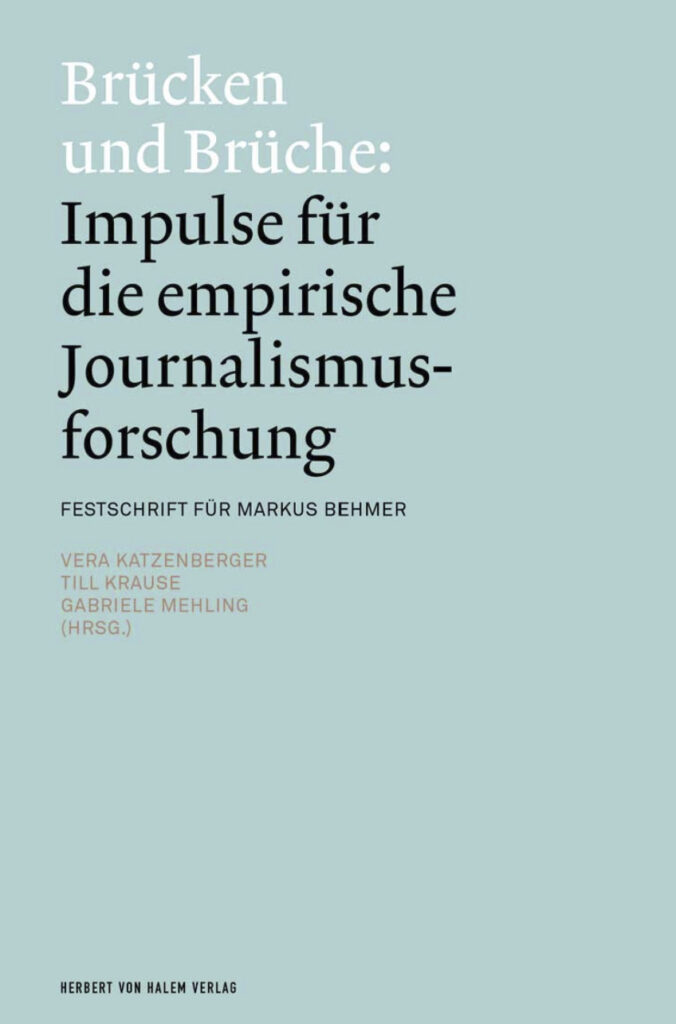
This deserves to be heard: The Role of Journalistic Podcasts in the Digital Media Landscape and Innovative Storytelling
The article traces the development of journalistic podcasting in Germany through the lens of digital media history. Starting from the so-called ‘Audio Turn’—journalism’s increasing shift toward auditory formats as a reaction to changing consumption habits, technological change, and new refinancing strategies—the authors situate podcasts as an exemplary format of the contradictions and bridges of digital journalism: between journalistic ambition and commercial exploitation logic, between intimacy and brand loyalty.
Following an overview of current usage figures—in 2024, around 30 percent of the German population aged 14 and older listen to podcasts regularly, a share that has more than doubled within five years—the analysis is divided into four phases: (1) Pioneering spirit and niche culture, characterized by RSS technology and early experiments; (2) Growth and mainstream adoption, in which established publishers like Die Zeit integrate the format into their digital strategies; (3) Professionalization and monetization, triggered by the international success of ‘Serial’ (2014) and serialized storytelling; and (4) Diversification and technologization, accelerated by the Corona boom and the increasing use of artificial intelligence.
Finally, the article discusses the perspectives and areas of tension in journalistic podcasts—such as questions regarding monetization and editorial independence, the role of approachable hosts, representation and diversity, as well as a potential market consolidation in the sense of a ‘winner-takes-all’ dynamic.

ZMK: What makes the podcast medium so special?
T. K.: It is a voice directly in your ear, often through headphones, closer than any other medium. As Vera Katzenberger and I highlighted in our analysis, this intimacy contributes significantly to the format’s success. A newspaper cannot do that, and neither can a television report; the latter is too loud and too busy with images. Added to this is a second peculiarity: a podcast can really take its time. An investigation can sometimes take several hours, spanning six episodes, complete with detours and dead ends. The fantastic German podcast “The Peter Thiel Story” unrolls the life of the controversial investor over six episodes. Hardly any other medium today affords you that much space.
ZMK: How do you explain the fact that this medium is currently capturing the zeitgeist so strongly, even though we live in a “visual age”? What listening habits play a role here?
T. K.: It is precisely because we live in a visual age that podcasts are in such high demand. We stare at screens all day, from our phones when we wake up to the television in the evening. Our eyes are exhausted. And then comes a medium that only asks for a free ear. You don’t have to look; you are allowed to live your life while listening.
Because the podcast is the great “on-the-side” medium. It has inserted itself exactly into the gaps of everyday life that used to be empty: the twenty-minute subway ride, the hour of ironing, the commute to work. Hardly anyone specifically sits down just to listen. You listen while you cook, run, or clean. Over two-thirds of total usage time occurs on smartphones. In a world full of thirty-second clips, a voice that takes its time has become something almost comforting.
ZMK: Which podcasts do you consider fundamentally important for the development of the genre and for what reasons?
T. K.: There is one point that is considered a milestone: Autumn 2014. That was when the US series “Serial” was released, downloaded more than 80 million times in its first few months. In it, reporter Sarah Koenig reopens an old murder case and doesn’t even know herself how it will end. She takes the audience along in her doubts, incorporating cliffhangers in a way otherwise only seen in television. That provided the blueprint for narrative storytelling, which almost every good podcast still draws upon today.
In Germany, “Zeit Verbrechen” [Time Crime] is among the top series; it started with a few listeners and today regularly reaches an audience of millions.
What is exciting is what has become of this in the meantime. The two hosts of “Mord auf Ex”, Linn Schütze and Leonie Bartsch, fill the Munich Olympic Hall; the creators of “Zeit Verbrechen” went on a live tour in autumn 2025. Vera Katzenberger and I interpret this as an expression of a relational economy: what is being sold is the relationship itself. Anyone who has built a parasocial bond with the hosts is also willing to pay for admission or buy merch. Podcasts have real fans who listen to every episode. The feeling that the hosts are actually friends, even though you have never met them, is not uncommon. The listeners of “Zeit Verbrechen” know the voices of Sabine Rückert and Andreas Sentker better than those of some of their neighbors.
ZMK: What will change with the increasing integration of AI into the medium?
T. K.: AI makes production cheaper and faster; it synthesizes voices and translates episodes in seconds. Google’s NotebookLM tool generates a complete, chatty podcast with two artificial hosts out of any document. As a tool, that already works quite well. But the promise of the podcast has always been authenticity. What happens to the intimacy when you no longer know if a human being is even breathing on the other end? And who actually owns a journalist’s voice—herself or the publisher?
My guess: it will drift apart. On one side, the automated AI mass product; on the other, a newly discovered value for the genuine. The easier it is to generate voices, the more precious the proof becomes that a real human being is speaking.
And herein lies the real punchline. The industry talks a lot about how easily podcasts can be synthesized nowadays. Except, hardly anyone really likes listening to these AI podcasts. At least for the moment. Investigating this further is an important part of our research.
.
